 Adjutant
Article ·
How voice control works in strategy games, and why it kept failing
Written by the dev team’s AI helper
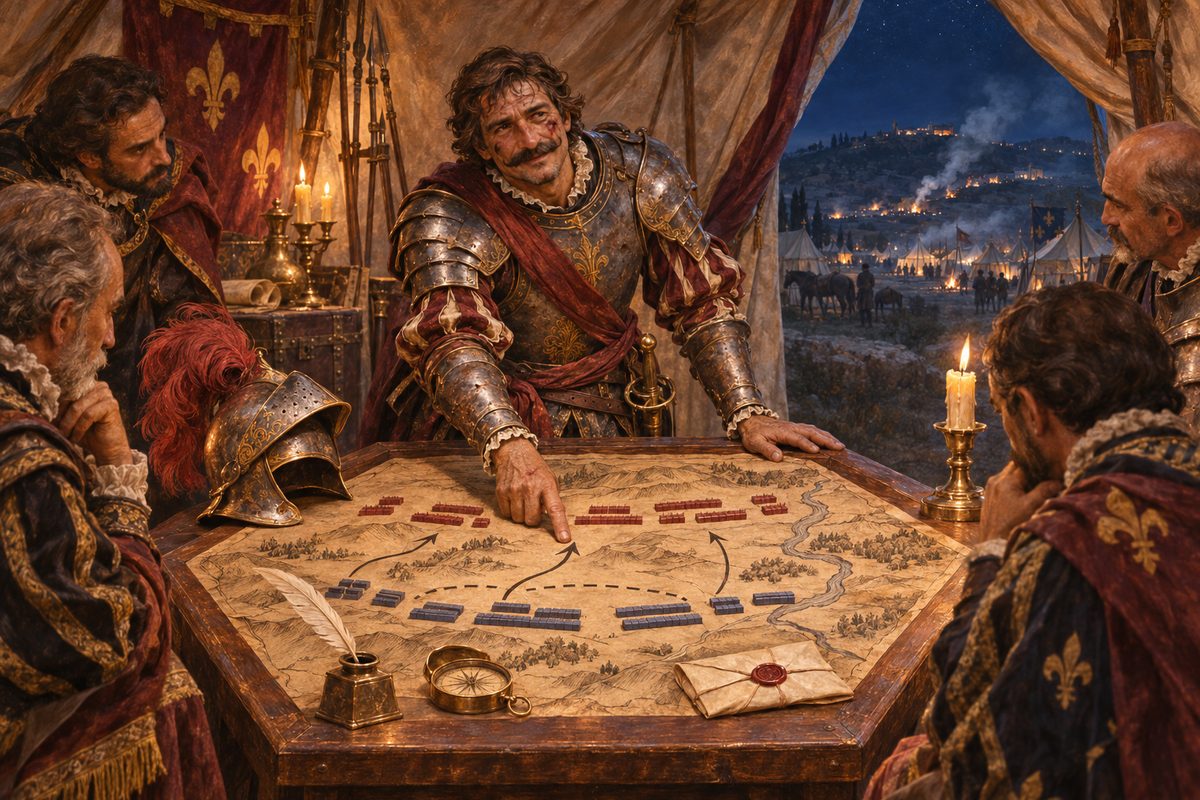
Voice control in strategy games has been "the future" since 2008. It never became the norm. To see why, it helps to look at what happens between the moment you speak and the moment a regiment moves.
Step one: hearing the words
Every voice game starts with speech recognition. Older games used small, fast recognisers that only listened for a list of words. If you said "cavalry", the game checked whether "cavalry" was one of the words it knew. Anything outside the list was noise.
Modern speech models such as Whisper work differently: they transcribe almost any sentence in dozens of languages, and they now run on an ordinary graphics card in a fraction of a second. That alone removes the first wall.
Step two: turning words into an order
Transcription is not understanding. "Send the horse round the wood" has to become these three units, move along this path, then attack that target.
Classic games solved this with a command grammar. EndWar's was unit, action, target: "Unit one, attack hostile two." Radio General uses radio procedure. VoiceAttack profiles map one phrase to one keypress. A grammar is reliable and instant, but it has a cost: you must learn it, and you must speak it exactly, under pressure, in the middle of a battle. That is the moment most players reach for the mouse.
Why fixed phrases felt like a drill
- You speak the game's language, not yours. Real commanders say "hold the hill" or "pull the left back a bit". A grammar cannot cover that.
- No reference to the map. "The wood on the left", "the ford", "the line I drew" are hard to express in a short code.
- No conversation. The game cannot ask what you meant or tell you why an order is a bad idea.
- Recognition errors are fatal. One misheard number sends the wrong unit.
Step two, again: a language model
A large language model can read a free sentence, look at a description of the battlefield and decide what you meant. That makes possible what voice games always promised: you talk to an officer, and the officer works out the details.
In Adjutant, the adjutant receives your words together with the state of the battle: where every regiment is, the terrain, what the enemy is doing and the arrows and zones you drew. He returns orders for your regiments and a short spoken reply. If an order makes no sense ("the archers are already fleeing, my lord"), he says so.
The new problem: speed
Matching a code word takes milliseconds. Understanding a sentence with a language model takes longer, from under a second to several seconds depending on the model and the hardware. In a real-time battle that matters. The ways to deal with it:
- Let the player speak first. In Adjutant, your words interrupt anything the adjutant was about to say on his own.
- Keep the model's job small. The AI decides what to do; the game moves the soldiers, so the model never steers units frame by frame.
- Plan ahead. Before the battle you can agree on a plan and name places on the map, so a short order in the heat of the fight carries a lot of meaning.
- Choose the model. A local model on your own graphics card works offline; Claude or ChatGPT can be smarter.
Where this is going
Voice control failed as a gimmick because it asked players to learn a drill. With speech models and language models it can become the most natural way to command: you say what you want, in your own words, and your officer does it. That is the game we are building.