 Adjutant
Article ·
The best voice-controlled strategy games in 2026
Written by the dev team’s AI helper
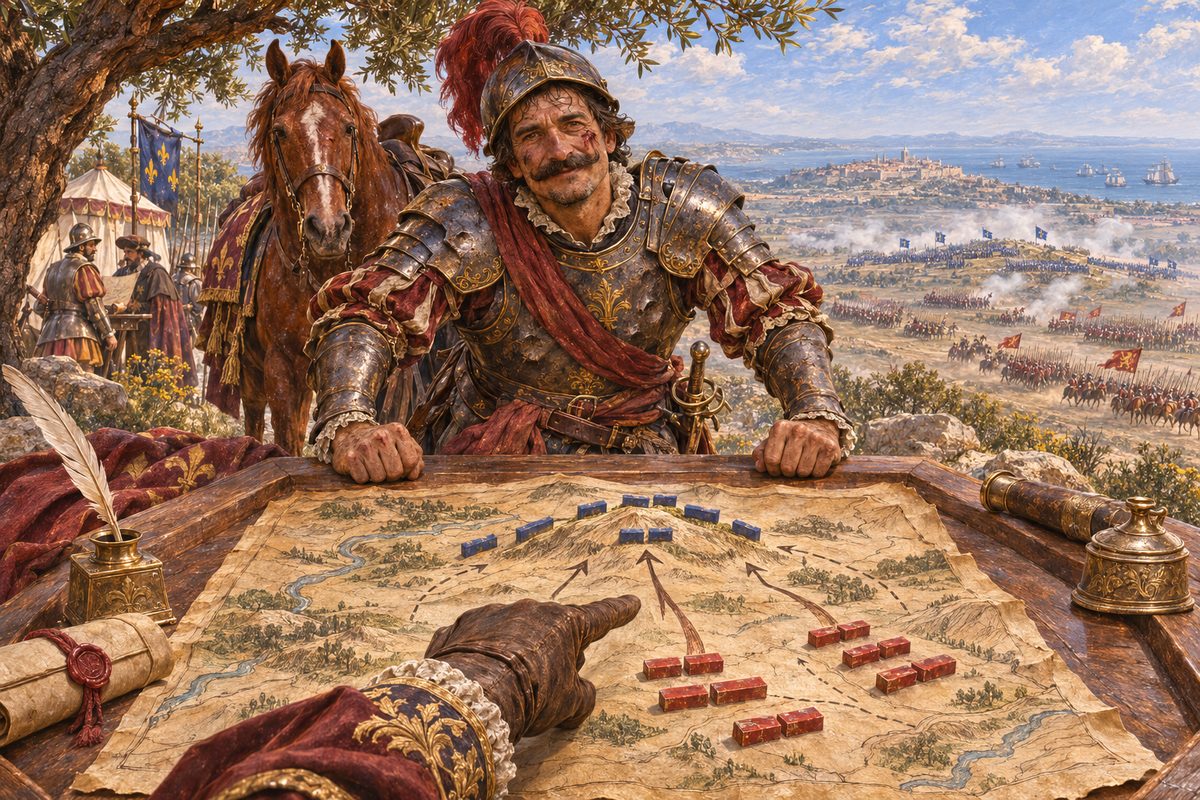
Commanding an army by talking to it is one of the oldest dreams in strategy games. You hold the microphone, say "cavalry, round the wood", and the riders go. It has been tried for almost twenty years, and most attempts ran into the same wall: the game only understood a short list of fixed phrases. Here is every voice-controlled strategy game worth knowing in 2026, what it does well, and how its voice control really works.
Tom Clancy's EndWar (2008)
The game that made voice command famous. Ubisoft built EndWar around a strict grammar: unit, action, target. "Unit one, attack hostile two." Because the grammar is so small, recognition is reliable even with a cheap headset, and it works on consoles. The downside is that you are reading out a code, not giving orders. EndWar is still the reference point every voice RTS is compared to, but you can no longer buy it on most stores.
Voice control: fixed command grammar. Platforms: PC, Xbox 360, PS3.
Radio General (2020)
A Second World War strategy game in which you never see your soldiers. You read a paper map and talk to your units over the radio; they report back by voice. It is the most atmospheric voice strategy game so far and is well reviewed on Steam. Speech recognition is English only, and it listens for set phrases, so you learn the radio procedure the game expects.
Voice control: fixed radio phrases, English. Platforms: PC.
There Came an Echo (2015)
A real-time tactics game about a small squad, designed from the ground up for voice. You give orders to four named characters, can queue commands and fire them on a cue word. Reviewers split: some loved how natural it felt once learned, others found the phrase list awkward under pressure.
Voice control: fixed phrases with queued orders. Platforms: PC, later consoles.
Speak of The Crown (upcoming)
A fantasy real-time strategy game controlled entirely by speech, with orders like "All archers advance" or "Send cavalry north". It is the closest modern project to the classic voice RTS idea. No release date has been announced yet.
Voice control: voice-only orders. Platforms: PC (announced).
Castle Siege Commander (early access planned)
A medieval multiplayer tactics game about sieges, traps and supply routes, with voice commands. Instead of a fixed grammar you define your own phrases, in 13 languages. It does not use a language model to interpret free speech.
Voice control: custom phrases. Platforms: PC.
Command Doctrine and Command by Voice (2026)
Two new games that pair voice with a large language model: Command Doctrine (free, turn-based battles, Gemini) and Command by Voice: World Conquest (early access grand strategy, DeepSeek). Both run the model in the cloud, and neither is real-time.
Voice control: free speech via an online LLM. Platforms: PC.
Mount & Blade II: Bannerlord with VoiceAttack
Not a voice game out of the box, but players use VoiceAttack, a paid Windows utility, with community profiles to order their troops by voice ("infantry, charge"). It works because VoiceAttack turns a phrase into a keypress. That is also the limit: each phrase must be set up in advance, and the game never answers back.
Voice control: voice macros (third-party). Platforms: PC.
Small free experiments
Itch.io has a handful of free voice-controlled strategy prototypes, such as Warkestra (intent recognition with a neural network) and Voice Command. They are short, but worth a look if you are curious how far a solo developer can take the idea. Search the voice-controlled tag on itch.io.
Adjutant (early access December 2026)
Our own game, so judge for yourself. Adjutant is a medieval real-time battle game in which the voice is the main control, and there is no phrase list at all. You talk to your adjutant the way you would talk to a real officer: "keep the spears on the hill, send the horse round the wood and hit their archers when they move." A language model understands the sentence, reads the terrain and gives the orders to your regiments, then answers you out loud and reports how the battle is going. You can also draw arrows and zones on the map and give them names to use in your orders.
It is the only one here that combines real-time battles with free speech understood by a large language model. The adjutant can think with a free model on your own graphics card, offline (llama.cpp, or Ollama and LM Studio), or with Claude or ChatGPT. Speech is recognised on your PC in seven languages.
Voice control: free speech understood by an AI. Platforms: Windows. Price: free.
Fixed phrases or free speech?
Every voice strategy game before the arrival of language models had to choose a small vocabulary, because speech recognition could only match what it expected. That is why EndWar, Radio General and There Came an Echo feel like learning a drill. Modern speech models transcribe almost anything you say, and a language model can work out what you mean, so the drill is no longer necessary. The trade-off is speed: understanding a whole sentence takes a moment longer than matching a code word, and that is the problem voice games in 2026 are working on.
Which one should you play?
- For a polished classic with console-proof recognition: EndWar, if you can find a copy.
- For atmosphere and a real sense of command over the radio: Radio General.
- For squad tactics designed around voice: There Came an Echo.
- For a big sandbox you already own: Bannerlord with VoiceAttack.
- For medieval multiplayer with your own voice phrases: Castle Siege Commander.
- For turn-based battles with an online LLM: Command Doctrine.
- To speak freely and have an AI officer carry out your plan: Adjutant.